Electronics 3 models
Sony Micro SD Card Breakdown: Reliability, Speeds, and Failure Risks
As Amazon Associates, we earn from qualifying purchases. This means we may receive a small commission at no extra cost to you if you click through and make a purchase.
Choosing the right flash memory card demands a close look at continuous write reliability, physical resilience, and how the storage controller handles unexpected power cuts or sustained bus traffic. When investigating options for a primary device, buyers often seek the best sony micro sd card setup to guarantee that photos, video streams, and audio files do not suffer fatal bitrot or block allocation errors. Evaluating flash hardware requires understanding that storage capacity is only one piece of the puzzle; sustained transfer rates, NAND wear distribution, and integrated data recovery provisions are what keep critical files intact across months or years of field operation.
This article covers three storage options designed for varied operating environments and host interfaces: a compact legacy microSDHC card built for basic mobile equipment and low-bitrate logging, an advanced UHS-II professional card engineered for fast offloading and harsh environmental exposures, and a high-write UHS-I alternative geared toward sustained 4K video workflows. By reviewing their internal speed ratings, environmental protection metrics, and software fail-safes, this sony micro sd card comparison clarifies how write limits and bus architectures dictate real-world longevity across diverse recording gear.
Which Sony Micro SD Card Should You Buy
- Low-capacity legacy handhelds, basic dash cameras, or older mobile phones requiring FAT32 compatibility benefit most from the Sony 8 GB microSDHC Flash Memory.
- Professional studio shooters and field photographers requiring rapid buffer clearance and accelerated computer offloading through UHS-II lanes should select the Sony 64GB E Series UHS-II SDXC.
- Content creators capturing continuous 4K video footage at 60 frames per second who need high sustained write speeds and extended recording capacity will find the Lexar 128GB Silver SD Memory Card best suited to their workflow.
Sony 8 GB microSDHC Flash Memory
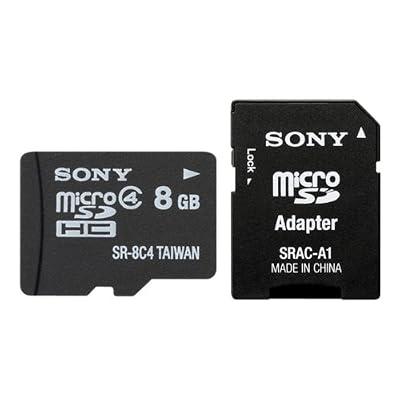
Sony 8 GB microSDHC Flash Memory
8.6/10 Our score
- Color
- 8GB
- Size
- 8GB
- Dimensions
- 4.8 x 0.25 x 6.1 inches
Best for: Legacy phones and low-bitrate digital frames
Pros
- Includes full-size SD adapter
- Waterproof physical construction
- Downloadable File Rescue software support
Cons
- Limited 4 MB/s Class 4 speed
- Small 8 GB storage capacity
The Sony 8 GB microSDHC Flash Memory card, model SR8A4, represents a purpose-built compact solution intended for legacy cell phones, basic digital photo frames, and compact digital cameras. Operating on the microSDHC standard with a Class 4 speed rating, this card guarantees a minimum sustained write baseline of 4 MB/s. While modest in an era of ultra-high-definition capture, this stable transfer floor makes the card well-suited for low-bitrate audio devices, legacy GPS units, and standard-definition photography where oversized storage partitions can cause host firmware crashes or directory indexing freezes. Readers using dedicated audio gear might also compare these capabilities against a sony recorder digital recorder setup that relies on stable, low-capacity storage media.
From an endurance and safety standpoint, this sony 8gb microsdhc unit incorporates waterproof construction to protect data against moisture exposure, condensation, or liquid spills. A standout inclusion highlighted in any technical sony sr8a4 review is Sony’s downloadable File Rescue software. This utility provides an emergency safeguard to recover photos and video files that have suffered accidental deletion or logical directory damage. The physical card package includes a full-sized SD adapter, allowing seamless file transfers to personal computers or direct insertion into full-frame card slots without requiring proprietary cables.
Prospective buyers must recognize the operational limitations of this flash architecture. With an 8 GB ceiling and a 4 MB/s media speed, the card will rapidly drop frames or trigger buffer overrun errors if forced to record modern 4K or high-bitrate Full HD video streams. NAND flash cells in smaller-capacity cards also cycle through write blocks more rapidly under daily continuous recording, which accelerates cell wear over time. If your workflow involves multi-gigabyte files, continuous burst shooting, or modern video bitrates, upgrading to a higher-capacity, modern V30 memory format is essential.
- Class 4 speed rating ensuring a dependable 4 MB/s minimum continuous transfer speed
- Included full-sized adapter allowing quick computer offloading and broad hardware connectivity
- Waterproof physical build protecting internal flash dies against liquid penetration
- Access to downloadable File Rescue software for recovering accidentally deleted or corrupted media
Sony 64GB E Series UHS-II SDXC

Sony 64GB E Series UHS-II SDXC
9.0/10 Our score
- Color
- Black
- Weight
- 0.03086471668 Pounds
Best for: Photographers demanding high-speed workstation offloading
Pros
- Fast 270 MB/s read speed
- Comprehensive environmental protection
- Built-in physical write-protect switch
Cons
- Moderate 45 MB/s maximum write speed
The Sony 64GB E Series UHS-II SDXC card transitions users into high-throughput professional media handling. Built on the SDXC standard with a dual-row pin layout for the UHS-II bus, this card achieves read speeds reaching up to 270 MB/s alongside a maximum write speed of 45 MB/s. It holds a V30 video speed class, Class 10 certification, and UHS Speed Class 3 (U3) rating, ensuring that write speeds will never dip below 30 MB/s during sustained continuous operation. This configuration makes it exceptionally capable for capturing Full HD, stereoscopic 3D, and 4K video sequences without dropping frames.
Physical protection is where this sony e series uhs-ii sdxc card sets an industry benchmark for field survival. The casing is engineered to withstand extreme temperatures, drops, dust ingress, prolonged UV exposure, and airport X-ray scanners, alongside comprehensive waterproof sealing. It also retains a physical write-protect switch on the card body—a crucial hardware feature that allows photographers to physically lock the card against accidental file overwriting or accidental formatting when handing off cards to third-party editors or inserting them into public terminals.
In terms of system reliability, the primary strength of this model is its rapid 270 MB/s read speed, which drastically shortens card-to-workstation transfer times when offloading large photo galleries. However, buyers should weigh its 45 MB/s write ceiling. While the 30 MB/s minimum threshold comfortably clears standard 4K workflows, sports photographers firing prolonged continuous RAW bursts may saturate the camera buffer quicker than with dedicated high-write cards. Sony backs this unit with a limited warranty, providing a reliable safety net against premature controller failure.
- UHS-II interface achieving rapid read speeds up to 270 MB/s for accelerated file dumping
- V30 and U3 ratings guaranteeing a minimum 30 MB/s write speed for reliable 4K video
- Comprehensive environmental defense against water, dust, drops, UV rays, and extreme temperatures
- Integrated physical write-protect switch to prevent accidental data overwriting
Lexar 128GB Silver SD Memory Card
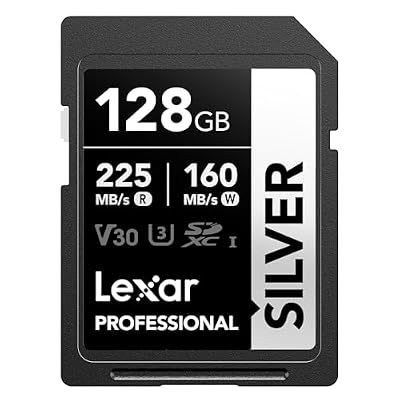
Lexar 128GB Silver SD Memory Card
8.8/10 Our score
- Color
- Silver
- Size
- 128GB
- Weight
- 0.0038125 Pounds
Best for: Creators capturing high-framerate 4K 60FPS video
Pros
- Fast 160 MB/s maximum write speed
- Generous 128 GB storage capacity
- Lifetime limited warranty coverage
Cons
- Limited to UHS-I interface bus
The Lexar 128GB Silver SD Memory Card expands storage capacity and write performance for demanding digital camera configurations. Utilizing a high-speed UHS-I interface, this card delivers maximum read speeds up to 225 MB/s and maximum write speeds up to 160 MB/s, with a sustained media speed listed at 140 MB/s. Rated for V30, U3, and Class 10 performance, it easily accommodates high-frame-rate 4K video recording at 60 frames per second, ensuring smooth video capture without dropped frames or compression artifacts caused by buffer throttling.
When examining overall card reliability, physical construction plays an enormous part in shielding flash cells from harsh fieldwork. This Lexar unit is certified drop-proof, temperature-proof, shockproof, vibration-resistant, magnetic-proof, X-ray-proof, and wearout-proof. These extensive mechanical ratings safeguard internal connections against repeated card slot insertion and rough transit. To complement its hardware protections, users receive access to the dedicated Lexar Recovery Tool for file restoration, backed by an impressive lifetime limited warranty that provides long-term assurance against manufacturing defects. Buyers evaluating alternative storage ecosystems can also examine sandisk mico sd hardware to understand how various manufacturers balance endurance warranties.
Compared to lower-capacity alternatives, the 128 GB volume provides broader wear leveling across NAND blocks, naturally prolonging the card’s operational lifespan by distributing program-erase cycles over more available flash memory. While its UHS-I bus design tops out just shy of the 270 MB/s read speeds delivered by UHS-II pinned cards, its substantially faster 160 MB/s write capability makes it far more versatile for continuous raw photography and high-bitrate video captures where write latency is the limiting factor.
- Substantial 128 GB storage volume allowing extended 4K 60FPS recording sessions
- Rapid 160 MB/s maximum write and 225 MB/s read speeds for seamless buffer clearing
- Rugged enclosure engineered to resist drops, shock, vibration, magnets, and thermal extremes
- Lexar Recovery Tool access paired with a comprehensive lifetime limited warranty
What Sets These Models Apart
Selecting among these storage devices requires matching bus interface throughput, flash memory volume, and protection tiers to your device’s operational environment. While micro form factors offer cross-device adaptability, dedicated full-size SDXC cards incorporate higher thermal dissipation surfaces and broader wear-leveling pools.
| Model | Storage Capacity & Form Factor | Speed Performance | Environmental Protection | Warranty Coverage |
|---|---|---|---|---|
| Sony 8 GB microSDHC Flash Memory | 8 GB microSDHC (includes full-size adapter) | Class 4 (4 MB/s minimum media speed) | Waterproof | Limited warranty |
| Sony 64GB E Series UHS-II SDXC | 64 GB SDXC (full size) | UHS-II, V30, 270 MB/s read, 45 MB/s write | Water, dust, drop, UV, extreme temperature, and X-ray proof | Limited warranty |
| Lexar 128GB Silver SD Memory Card | 128 GB SDXC (full size) | UHS-I, V30, 225 MB/s read, 160 MB/s write | Drop, wearout, vibration, shock, magnet, temperature, and X-ray proof | Lifetime limited warranty |
The primary technical distinction among these cards lies in the bus architecture and write speed floors. The Class 4 microSDHC module relies on standard high-speed bus signaling, capping sustained writes at 4 MB/s. In contrast, the UHS-II implementation on the Sony E Series introduces a second row of physical interface pins, enabling ultra-fast read bandwidth of 270 MB/s without overwhelming the host controller. Meanwhile, the Lexar Silver utilizes a refined UHS-I controller capable of pushing write bursts up to 160 MB/s. Capacity also directly dictates how the memory controller handles solid-state cell degradation: an 8 GB partition rewrites the same NAND cells sixteen times more frequently than a 128 GB partition under identical data volumes, directly impacting long-term device longevity.
Buying Tips for Sony Micro SD Cards
Flash memory durability is fundamentally dictated by write endurance, controller behavior, and the physical integrity of the memory package. When shopping for storage media, buyers must evaluate the specific write load their host hardware generates. High-resolution action cams, dash recorders, and 4K digital cameras continuously write uncompressed data streams that quickly overwhelm low-speed classes. Using a Class 4 card in a modern device often results in sudden recording terminations, buffer lockups, or corrupted video file containers. For video capturing, always verify that the card carries at least a V30 designation to guarantee that write throughput never falls below the 30 MB/s threshold during thermal throttling.
Physical environmental hazards pose an equally grave risk to long-term data preservation. Field recording frequently exposes memory cards to extreme ambient temperatures, humidity, static electricity, and rough mechanical handling. Choosing cards rated against drops, thermal variations, moisture, and airport X-ray machinery prevents hardware shorts and catastrophic cell gate breakdown. Furthermore, full-size SD cards equipped with physical write-protect switches provide an extra mechanical barrier, preventing host devices or shared computers from executing unintended formatting routines or destructive write operations on archived footage.
Data recovery planning should always accompany any flash memory deployment. Regardless of how reliable a brand is, all solid-state media remains susceptible to logical corruption caused by abrupt power loss, accidental removal during write cycles, or directory allocation table faults. Utilizing integrated manufacturer recovery utilities—such as Sony File Rescue or the Lexar Recovery Tool—provides a critical line of defense for carving raw image fragments from damaged sectors. To maintain optimal file system health, always format memory cards directly inside the host device prior to significant shooting sessions rather than relying on computer operating system formatting routines.
FAQ
How does the sony memory card failure rate compare to other brands?
Solid-state memory failure rates depend heavily on write cycling, thermal conditions, and controller quality. Sony storage cards generally demonstrate solid operational reliability due to built-in environmental shielding against moisture, UV rays, and shock. However, flash memory will inevitably degrade if subjected to continuous write cycles that exceed the NAND cell endurance. Cards with smaller capacities, such as 8 GB modules, experience faster cell exhaustion than 64 GB or 128 GB cards because wear-leveling algorithms have fewer spare blocks to rotate through during intensive writing.
What is covered under the standard sony micro sd card warranty?
The sony micro sd card warranty typically operates as a limited warranty that protects against verified manufacturing flaws, internal controller defects, and early component failure under normal operating parameters. It does not cover data loss, normal wear and tear from reaching maximum write cycles, or physical breakage caused by user negligence. Because warranty terms exclude the financial value of stored files, maintaining secondary local and offsite backups remains essential for protecting critical data.
Which sony micro sd card to buy for modern 4K video recording?
For 4K video recording, you must select a card rated at minimum V30 (Video Speed Class 30), such as the Sony 64GB E Series UHS-II SDXC card. The legacy Class 4 Sony 8 GB microSDHC Flash Memory cannot sustain the required write bandwidth for 4K video and will cause the host camera to stall or abort recording. Cards with V30 certification guarantee at least 30 MB/s of continuous sequential write capability, ensuring smooth video capture without dropped frames.
Can a microSDHC card with an SD adapter be used safely in professional cameras?
While a microSDHC card fitted with an SD adapter provides physical compatibility with full-size camera slots, it introduces additional physical contact points that can increase resistance or disconnect momentarily under heavy vibration. For high-speed burst photography or professional video jobs, dedicated full-size SDXC cards are preferable because their unified internal layout reduces connection latency, improves heat dissipation, and eliminates mechanical adapter flex.
What should you do if a Sony memory card becomes corrupted or unreadable?
If a memory card becomes unreadable or prompts for formatting, immediately stop using the card to avoid overwriting damaged memory blocks. Remove the card and run Sony File Rescue software on a computer to scan the flash sectors for recoverable image and video files. Never format the card before attempting file extraction, as formatting resets the file allocation table and complicates deep sector recovery.
Prices and specifications on this page are read from the Amazon product listing and can change at any time. Scores are out of 10, based on listed specifications and buyer feedback. Nobody at this site handled or measured these products.


