Electronics 6 models
Ubiquiti Network Switches: Reliability and Hardware Comparison
As Amazon Associates, we earn from qualifying purchases. This means we may receive a small commission at no extra cost to you if you click through and make a purchase.
Selecting an enterprise-grade or small-office ubiquiti network switch requires evaluating port density, switching capacity, and Power over Ethernet thermal margins. Network administrators frequently face hardware degradation when switches operate near maximum PoE wattage thresholds or in poorly ventilated telecom cabinets. Hardware longevity depends directly on how thermal dissipation is managed, whether an internal or external power brick delivers the current, and whether passive fanless cooling can withstand sustained data and power loads in ambient environments up to 40 °C.
This comprehensive ubiquiti network switch comparison examines six distinct hardware models across the product lineup. We analyze compact edge devices, wall-mounted mid-tier distribution units, full-width rackmount hardware, and high-density multi-gigabit enterprise switches. By reviewing power supply efficiency, thermal ceilings, chassis materials, and Layer 2 versus Layer 3 switching logic, this evaluation clarifies which ubiquiti network switch to buy based on operational demands and hardware reliability.
Which Ubiquiti Network Switches Should You Buy

Ubiquiti
8.4/10 Our score
- Color
- multicoloured
- Size
- Standard
- Dimensions
- 7.87401574 x 5.905511805 x 5.905511805 inches
- Quiet desktop environments needing modest PoE power: 8-Port PoE Network Switch by Ubiquiti
- Compact utility spaces and edge endpoints powered via USB-C or PoE: Ubiquiti Compact 5-Port Gigabit Switch
- Wall-mounted office networks requiring balanced PoE+ distribution: Ubiquiti
- Standard equipment racks needing high-density data switching without PoE: Ubiquiti Networks UniFi USW-24 Switch
- Flexible remote deployments demanding power source versatility: Ubiquiti USW-Ultra-60W
- Enterprise infrastructures requiring 2.5 GbE backhaul and high-wattage PoE++: Ubiquiti USW-Pro-Max-48-PoE
8-Port PoE Network Switch by Ubiquiti

8-Port PoE Network Switch by Ubiquiti
9.6/10 Our scoreTop scored: 9.4/10 or higher
- Dimensions
- 6.44 x 3.92 x 1.25 inches
- Weight
- 0.65 Pounds
The 8-Port PoE Network Switch by Ubiquiti serves as an entry-level Layer 2 distribution unit designed for quiet workspaces and local desktop installations. Built with a lightweight polycarbonate housing measuring 6.44 by 3.92 by 1.25 inches and weighing just 10.4 ounces, this compact appliance integrates cleanly into constrained spaces. Because it operates with silent fanless cooling, it eliminates acoustic noise entirely, making it suitable for placement near workstations, personal computers, and office printers without causing acoustic distraction.
From an electrical and thermal perspective, this switch relies on an external 60W power adapter to supply a total PoE capacity of 52W across its RJ45 interfaces. Externalizing the AC-to-DC conversion stage isolates the heat generated by the transformer from the internal switching logic, significantly reducing internal thermal stress. The unit maintains an operating envelope ranging from a lower temperature rating of 5 °F to an upper temperature rating of 104 °F (40 °C). For deployments requiring reliable power for low-draw devices, maintaining headroom below the 52W maximum threshold prevents premature thermal throttling.
While the passive thermal design protects against internal fan bearing failures, the polycarbonate chassis does not dissipate heat as aggressively as extruded aluminum or steel enclosures. Users deploying multiple high-draw devices should monitor ambient airflow carefully. When network demands expand beyond 8 ports or require rack integration, this desktop model gives way to larger distribution hardware with higher port counts and metal enclosures.
- Silent fanless passive cooling design
- External 60W power adapter delivering 52W PoE budget
- Layer 2 switching across 8 RJ45 ports
- Operating temperature range from 5 °F to 104 °F
Ubiquiti Compact 5-Port Gigabit Switch
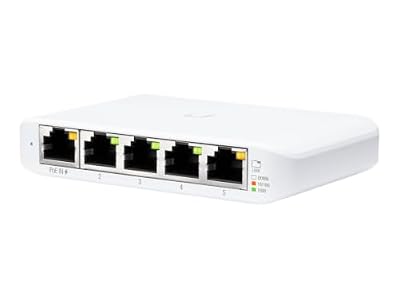
Ubiquiti Compact 5-Port Gigabit Switch
8.8/10 Our score
- Color
- Information Not Available
- Size
- 0.8" x 4.2" x 2.8"
- Dimensions
- 2.8 x 4.2 x 0.8 inches
Designed for space-constrained edge locations, the Ubiquiti Compact 5-Port Gigabit Switch delivers versatile connectivity in a remarkably small footprint. This Layer 2 managed switch provides 5 RJ45 ports, operating as an efficient desktop expansion node. Its defining engineering feature is flexible power input: the switch can be energized either via an upstream 802.3af/at PoE connection or through an alternate 5V USB Type-C input, eliminating the absolute necessity of a dedicated wall outlet near the switch chassis.
Deploying this compact 5-port gigabit switch at an entertainment center, desk, or remote workstation simplifies network segregation. The listing highlights extensive software-defined management features, including centralized configuration management, configuration cloning, Auto-MDIX cable sensing, and independent per-port switching or port mirroring modes. It also supports advanced networking options such as jumbo frames, flow control services, storm control per port, and full VLAN configurations. For users powering edge gear through structured cabling, pairing this unit with a dedicated ubiquiti poe adapter provides consistent input voltage.
The unit features a plastic housing and an energy-efficient profile with a listed maximum power draw of 30 watts and an upper temperature threshold of 40 °C. Because it is engineered purely for endpoint expansion rather than power distribution, it does not supply downstream PoE to attached clients. Systems requiring downstream power delivery to access points or cameras must step up to powered distribution units like the 8-port or 16-port PoE models.
- Dual power options via 802.3af/at PoE input or USB Type-C
- Five Gigabit RJ45 Ethernet ports with Auto-MDIX
- Managed Layer 2 features including VLANs and storm control
- Compact desktop plastic footprint with passive cooling
Ubiquiti
Ubiquiti
8.4/10 Our score
- Color
- multicoloured
- Size
- Standard
- Dimensions
- 7.87401574 x 5.905511805 x 5.905511805 inches
The Ubiquiti USW-Lite-16-PoE represents a pivotal transition point between desktop edge devices and full enterprise distribution racks. Encased in a durable metal chassis measuring 7.87 by 5.91 by 5.91 inches, this 16-port switch is built for structured media cabinets and office wall mounting. It includes a dedicated wall mount kit, allowing network installers to orient the ports vertically to maximize natural convective airflow across the internal components.
Port architecture is divided to balance high-speed data transmission and device powering: the unit features 16 Gigabit ports, eight of which provide automatic 802.3at PoE+ sensing. These eight PoE+ interfaces share an aggregate power budget of 45W, driven by an included 60W external power adapter. Centralized management is handled seamlessly through the UniFi Network Controller and mobile application, giving administrators real-time visibility into per-port power consumption, Layer 2 switching protocols, and VLAN tagging. Ubiquiti poe switch reliability in this form factor relies heavily on staying within the 45W ceiling, particularly when powering high-consumption endpoints.
The metal enclosure acts as an effective passive heatsink, dissipating thermal energy without requiring mechanical fans that could gather dust or fail over time. However, with an aggregate power pool of 45W spread across 8 ports, administrators must calculate power draw meticulously. Connecting multiple long-range access points alongside an ubiquiti outdoor camera can quickly exhaust the power budget. When power or port requirements exceed these boundaries, installations transition naturally to dedicated 24-port or 48-port enterprise switches.
- Sixteen Gigabit RJ45 ports including eight auto-sensing 802.3at PoE+ ports
- Robust metal enclosure with included wall mount bracket
- 45W maximum PoE power allocation via external 60W supply
- Centralized management via UniFi Network Controller and mobile app
Ubiquiti Networks UniFi USW-24 Switch

Ubiquiti Networks UniFi USW-24 Switch
8.0/10 Our score
- Color
- black
- Dimensions
- 8.6614 x 3.1496 x 1.1811 inches
- Weight
- 6.61386786 pounds
For installations that demand high-density wired data connectivity without the thermal complexity of PoE power supplies, the Ubiquiti Networks UniFi USW-24 Switch provides a robust rackmount solution. This full-width 1U rackmount appliance features 24 Gigabit RJ45 Ethernet ports alongside two 1G SFP slots for fiber uplinks or cross-switch interconnects. Constructed with a rigid black metal enclosure weighing 3 kg, it is engineered for structured data racks in commercial and residential server environments.
Because the USW-24 is a non-PoE switch, its internal operational thermals remain substantially lower than those of PoE-equipped counterparts. Without the high heat generation associated with internal AC-to-DC PoE converters, the switch maintains stable operation well within its rated 40 °C upper ambient temperature limit. The dual SFP cages provide dedicated uplink bandwidth, preventing data bottlenecks between network tiers while keeping all 24 copper ports available for local client connectivity.
Running on a managed Layer 2 switching architecture supported by a Linux-based platform, this ubiquiti unifi switch offers extensive traffic management capabilities. It supports configuration auditing, port isolation, link aggregation, and network-wide VLAN distribution. For organizations operating dedicated patch panels where endpoint devices use separate power injectors, the USW-24 minimizes hardware failure points. It gives way to alternative models only when direct, centralized PoE injection is required across the patch field.
- Twenty-four Gigabit Ethernet RJ45 data ports
- Two dedicated 1G SFP uplink cages for fiber expansion
- Rackmount 1U form factor with durable 3 kg metal construction
- Low-heat non-PoE architecture for maximum component longevity
Ubiquiti USW-Ultra-60W

Ubiquiti USW-Ultra-60W
8.8/10 Our score
- Color
- White
- Dimensions
- 3.93700787 x 1.968503935 x 0.49999999949 inches
- Weight
- 0.7054792384 pounds
The Ubiquiti USW-Ultra-60W is an ultra-compact Layer 2 managed switch developed to solve complex power distribution challenges at the network perimeter. Featuring a clean white exterior measuring just 5.75 by 3.89 by 1.05 inches, this device delivers 8 total Gigabit Ethernet ports with exceptional power routing options. It incorporates 7 GbE PoE+ output ports and 1 GbE input port capable of accepting optional PoE++ power from an upstream source.
When powered by its included 60W external AC power adapter, the USW-Ultra-60W provides a dependable 52W PoE power availability across its output interfaces. This flexibility allows technicians to deploy the unit as a standard locally powered desktop switch or as an inline power distribution bridge fed by an upstream high-power switch. Managing power delivery across 7 output ports requires precise monitoring, especially when operating in ambient conditions approaching its 40 °C upper temperature rating.
The versatile mounting chassis supports horizontal desktop resting, magnetic adhesion, or wall mounting, making it highly adaptable to structured wiring boxes. With an 8 Gbps non-blocking switching throughput, the switch handles saturated local traffic without dropping frames. It represents an optimal middle ground for compact security installations, yielding to larger rackmount hardware only when total port counts exceed 8 or multi-gigabit throughput is mandatory.
- Seven Gigabit PoE+ output ports with one PoE++ input port
- 52W available PoE capacity using included 60W AC adapter
- Compact Layer 2 managed architecture with 8 Gbps switching capacity
- Versatile mounting options for desktop, wall, or structured enclosures
Ubiquiti USW-Pro-Max-48-PoE

Ubiquiti USW-Pro-Max-48-PoE
8.6/10 Our score
- Color
- Information Not Available
- Size
- 1.7" x 17.4" x 15.7"
- Dimensions
- 15.7 x 17.4 x 1.7 inches
At the apex of high-density enterprise switching sits the Ubiquiti USW-Pro-Max-48-PoE. This enterprise hardware platform delivers 48 high-performance switching ports combined with Layer 3 routing capabilities. The port configuration is engineered for next-generation throughput: it includes sixteen 2.5 GbE ports (split evenly between 8 PoE+ and 8 high-output PoE++ ports) and thirty-two 1 GbE ports (composed of 24 PoE+ and 8 PoE++ ports). Four 10G SFP+ cages provide ultra-wide optical uplinks to aggregation cores.
A primary diagnostic innovation on this model is its Etherlighting technology. Each port features integrated illumination that visually communicates port location, active link speed, and native VLAN assignment directly on the RJ45 faceplate. This visual feedback dramatically speeds up patch cable tracing and physical port verification in dense server rooms. System builders deploying modern Wi-Fi 7 access points or high-bandwidth workstations will benefit from pairing this device with a dedicated unifi 2.5gb switch strategy to maximize multi-gigabit throughput.
Operating on 120V mains power with a listed maximum consumption profile of 100 watts and support for external DC backup power, this unit is engineered for enterprise availability. Layer 3 routing functions offload inter-VLAN routing from the primary gateway, preserving core routing cycles and minimizing network latency. The USW-Pro-Max-48-PoE represents an advanced hardware tier, superseding compact and non-PoE alternatives whenever large-scale multi-gigabit routing, high PoE++ power budgets, and 10G optical uplinks are required.
- Sixteen 2.5 GbE ports and thirty-two Gigabit ports with PoE+ and PoE++ output
- Four high-speed 10G SFP+ uplink ports
- Layer 3 switching capabilities and integrated DC power backup support
- Etherlighting port illumination for link speed and VLAN identification
What Sets These Models Apart
| Model | Port Count and Speeds | PoE Power Delivery | Chassis Material and Form Factor | Switching Layer |
|---|---|---|---|---|
| 8-Port PoE Network Switch by Ubiquiti | 8 x 1 GbE RJ45 | 52W PoE Budget (60W Adapter) | Polycarbonate Desktop | Layer 2 |
| Ubiquiti Compact 5-Port Gigabit Switch | 5 x 1 GbE RJ45 | No Output (PoE / USB-C Input) | Plastic Desktop | Layer 2 |
| Ubiquiti (USW-Lite-16-PoE) | 16 x 1 GbE RJ45 | 45W PoE+ Budget across 8 Ports | Metal Wall-Mount / Desktop | Layer 2 |
| Ubiquiti Networks UniFi USW-24 Switch | 24 x 1 GbE RJ45 + 2 x 1G SFP | Non-PoE Data Only | Metal 1U Rackmount | Layer 2 |
| Ubiquiti USW-Ultra-60W | 8 x 1 GbE RJ45 | 52W PoE+ Budget (PoE++ Input Capable) | Compact Desktop / Wall-Mount | Layer 2 |
| Ubiquiti USW-Pro-Max-48-PoE | 16 x 2.5 GbE + 32 x 1 GbE + 4 x 10G SFP+ | Extensive PoE+ and PoE++ Output | Enterprise Rackmount | Layer 3 |
Buying Tips for Ubiquiti Network Switches
When selecting a network switch, calculating aggregate PoE power consumption is the most critical step in preventing unexpected hardware resets and thermal degradation. Devices like motorized pan-tilt-zoom cameras, high-output wireless access points, and VoIP phones draw variable wattage based on processing load and environmental conditions. Always ensure your total connected power draw does not exceed 80 percent of the switch’s rated PoE budget. Running a power supply continuously at 100 percent capacity accelerates capacitor wear and increases operating temperatures.
Thermal management is equally crucial for equipment reliability. Fanless desktop and wall-mounted models rely entirely on passive radiation and convective airflow. Installing fanless switches inside sealed plastic utility boxes or tight enclosures without ventilation will elevate ambient temperatures above the 40 °C upper rating, inducing thermal throttling or intermittent port drops. For unventilated enclosures, prioritize non-PoE switches or external power supply designs that keep the AC transformer separated from internal switching circuits.
Finally, match the physical installation environment to the chassis design. Sheet metal enclosures offer superior passive heat sinking and physical resilience compared to polycarbonate models, making metal units preferable for commercial closets and wall mounting. If your infrastructure involves interconnecting switches across floors or separate buildings, prioritize models equipped with SFP or SFP+ cages to take advantage of optical isolation, which eliminates ground loop hazards and provides dedicated uplink bandwidth.
FAQ
What causes a fanless PoE switch to overheat?
Fanless switches overheat primarily when deployed in enclosed, unventilated spaces or when operated near their maximum PoE power budget. Because passive switches rely on natural convection to radiate heat through their chassis, restricting airflow causes thermal energy to build up quickly. Operating high-wattage PoE devices continuously further elevates the internal transformer and component temperatures.
Can I power an access point with the 5-port compact desktop switch?
No, the listing specifies that the 5-port compact model does not provide downstream PoE output. It can receive power via an 802.3af/at PoE input or a USB Type-C connection, but its 5 RJ45 ports function solely as data interfaces for connecting computers, media consoles, or other powered endpoints.
What is the benefit of an external power adapter on switches like the USW-Ultra-60W?
An external power supply separates the high-heat AC-to-DC conversion hardware from the switch’s delicate internal silicon and switching chips. This physical separation lowers internal chassis temperatures, improves overall component reliability, and allows for straightforward power brick replacement if an electrical surge damages the adapter.
When is Layer 3 switching necessary instead of Layer 2?
Layer 3 switching is necessary when you need to route traffic between different VLANs directly on the switch hardware without sending data packets back through your central router or gateway. This hardware routing reduces bandwidth congestion on router interfaces and significantly lowers inter-VLAN latency in high-density corporate networks.
How do SFP ports improve network reliability compared to standard RJ45 ports?
SFP and SFP+ ports accommodate fiber-optic transceivers that transmit data using light rather than electrical signals. Fiber uplinks provide complete galvanic isolation between network switches, protecting equipment from ground voltage differentials and lightning-induced electrical surges that can travel across long copper Ethernet cables.
Prices and specifications on this page are read from the Amazon product listing and can change at any time. Scores are out of 10, based on listed specifications and buyer feedback. Nobody at this site handled or measured these products.


