Electronics 6 models
TP-Link Deco Internet Extender Comparison: Reliability, Ports, and Real-World Coverage
As Amazon Associates, we earn from qualifying purchases. This means we may receive a small commission at no extra cost to you if you click through and make a purchase.
When weak signal pockets disrupt local connectivity, deploying a deco internet extender setup offers a resilient alternative to traditional plug-in boosters. Standard wireless extenders merely repeat an existing transmission on degraded frequencies, creating separate network names and cutting available throughput in half. TP-Link Deco units operate on a unified mesh protocol, dynamically coordinating client handoffs and balancing backhaul communication across nodes so devices maintain a singular, uninterrupted connection across the property.
This comprehensive tp-link wifi extender comparison covers six distinct TP-Link configurations designed to expand coverage across different physical environments and traffic loads. These hardware options vary across wireless generations, from budget Wi-Fi 5 systems to tri-band Wi-Fi 6E and next-generation Wi-Fi 7 hardware. Key technical distinctions center on physical port counts, WAN and LAN throughput limits, dedicated backhaul spectrum allocation, and embedded operating firmware. Examining these differences allows you to determine which tp-link wifi extender to buy based on your wiring setup, interference levels, and broadband speed tier.
Which TP-Link WiFi Extenders Should You Buy
- Targeted single-room expansion on modern Wi-Fi 6 networks: TP-Link Deco WiFi 6 Mesh WiFi
- Balanced multi-room Gigabit coverage with three ports per node: TP-Link Deco X55 AX3000 WiFi 6 (3-Pack)
- Modular single-node additions to an existing Deco mesh: TP-Link Deco X55 AX3000 WiFi 6 (1-Pack)
- Large-footprint coverage for standard broadband speeds: TP-Link Deco S4 Mesh AC1900 WiFi
- High-traffic environments demanding multi-gigabit routing and 10G interfaces: Deco 7 Pro Tri-Band WiFi 7
- Congested residential areas requiring dedicated 6 GHz backhaul channels: TP-Link Deco XE75 AXE5400 Tri-Band WiFi
TP-Link Deco WiFi 6 Mesh WiFi

TP-Link Deco WiFi 6 Mesh WiFi
8.2/10 Our score
- Color
- White
- Size
- 1 Pack
- Dimensions
- 4.33 x 4.33 x 4.49 Inches
Best for: Budget single-room Wi-Fi 6 expansion
Pros
- Wi-Fi 6 speeds
- Two Gigabit ports
- WPA3 security support
Cons
- Dual-band wireless backhaul only
- Limited to 1,775 Mbps data rate
The TP-Link Deco WiFi 6 Mesh WiFi system, supplied as a standalone Deco X20 unit, delivers entry-level Wi-Fi 6 networking to address individual dead zones without full infrastructure overhaul. Operating on dual-band 802.11ax architecture, this unit reaches cumulative transfer rates up to 1,775 Mbps across its 2.4 GHz and 5 GHz radios. It replaces conventional range repeaters by integrating directly into an existing network or serving as an autonomous gateway. For users planning broader network topology, pairing the node alongside an existing deco mesh router ensures continuous signal negotiation across the residence.
Hardware connectivity on this tp-link deco x20 node includes two auto-sensing Gigabit Ethernet ports. These interfaces handle WAN routing or wired local device connections, while also functioning as a hardwired Ethernet backhaul link to maintain peak stability. Internally, the module relies on internal antennas managed by TP-Link OS, incorporating OFDMA and MU-MIMO to maintain communication integrity across multiple simultaneous endpoints. Built-in parental control profiles and WPA3 security protocols provide essential control over household traffic without requiring subscription enhancements.
Because the unit relies on dual-band transmission, deploying it as a wireless extender means backhaul traffic and local client communication share the 5 GHz band. This shared frequency causes throughput attenuation if placed too far from the parent gateway. Homeowners requiring dedicated high-speed links in outlying rooms will achieve optimal results by joining this unit via structured Ethernet wiring rather than relying strictly on over-the-air relay.
- AX1800 Wi-Fi 6 wireless performance delivering up to 1,775 Mbps
- Coverage capacity rated up to 2,200 square feet per single node
- Two Gigabit Ethernet interfaces with WAN and LAN auto-sensing
- TP-Link OS integration featuring WPA3 encryption and basic parental controls
TP-Link Deco X55 AX3000 WiFi 6

TP-Link Deco X55 AX3000 WiFi 6
8.2/10 Our score
- Size
- 1 Pack Indoor
- Dimensions
- 4.33 x 4.33 x 4.49 inches
Best for: Targeted coverage expansion for single dead zones
Pros
- Three Gigabit Ethernet ports
- Up to 2,500 square feet coverage
- HomeShield security features
Cons
- Single unit limits mesh roaming benefit
- Dual-band throughput sharing

TP-Link Deco X55 AX3000 WiFi 6
9.2/10 Our score
- Color
- Black, White
- Size
- 3 Pack Indoor
- Dimensions
- 4.33 x 4.33 x 4.49 inches
Best for: Multi-room homes seeking balanced Gigabit coverage
Pros
- Three Gigabit ports per node
- 6,500 square feet three-pack range
- Two-year warranty included
Cons
- Shares 5 GHz band for backhaul
- Requires app for management
Supplied as a three-pack system, the TP-Link Deco X55 AX3000 WiFi 6 represents a substantial functional upgrade over entry-level dual-band kits. Each module delivers dual-band AX3000 speeds, combining 2,402 Mbps on the 160 MHz-capable 5 GHz band with 574 Mbps on the 2.4 GHz spectrum. Across all three included stations, the kit provides seamless blanket coverage reaching up to 6,500 square feet. This multi-node configuration is suited for mid-sized and large residential properties where dense building materials create signal obstruction.
Physical interface capacity is a major strength of this tp-link deco x55 three-pack. Every individual station is equipped with three Gigabit Ethernet ports, yielding nine total wired ports across the entire system. Any single unit can operate as the primary router connected to your internet service provider modem, while the remaining ports handle network switches, gaming systems, or wired backhaul links. Management runs on TP-Link Omada software architecture, backed by TP-Link HomeShield for basic network security, quality of service management, and parental filtering. Notably, TP-Link confirms compliance with the CISA Secure-by-Design pledge and provides a two-year hardware warranty paired with 24/7 technical support.
While the 160 MHz channel support substantially enhances wireless transfers between compatible clients, the dual-band design requires careful physical placement. Without a third dedicated radio for node-to-node relay, wireless backhaul traffic competes with client streams on the 5 GHz band. To prevent speed degradation at the furthest node, establishing wired Ethernet backhaul across the three units is recommended for demanding users.
- AX3000 dual-band Wi-Fi 6 with 160 MHz channel bandwidth support
- Broad residential coverage spanning up to 6,500 square feet for up to 150 devices
- Three Gigabit Ethernet ports per unit supporting wired backhaul routing
- Two-year warranty and CISA Secure-by-Design cybersecurity commitment
TP-Link Deco X55 AX3000 WiFi 6
TP-Link Deco X55 AX3000 WiFi 6
9.2/10 Our score
- Color
- Black, White
- Size
- 3 Pack Indoor
- Dimensions
- 4.33 x 4.33 x 4.49 inches
The single-pack TP-Link Deco X55 AX3000 WiFi 6 package contains an identical hardware chassis to the multi-pack modules, designed specifically for modular network expansion or compact apartment deployments. It delivers coverage up to 2,500 square feet from a single footprint, leveraging Wi-Fi 6 AX3000 dual-band radios capable of 3,000 Mbps aggregate transfer speeds. Because every Deco unit retains full operational software parity, this standalone hardware can deploy either as an independent central router or as a supplemental mesh node linked to an existing Deco setup.
Integrating this single tp-link deco x55 unit resolves stubborn dead spots in detached garages, remote home offices, or basement workshops. It houses three Gigabit Ethernet ports with auto-sensing capabilities, allowing users to connect multiple local peripheral devices like desktop computers, network-attached storage, or television hubs without deploying secondary desktop switches. Specification documentation notes Tenda OS integration alongside WPS functionality, WPA3 wireless encryption, and TP-Link HomeShield basic network monitoring. The hardware is backed by TP-Link’s standard two-year warranty and round-the-clock technical assistance.
When deployed as an isolated range extender across long distances, buyers must note that physical obstructions attenuate the 5 GHz 160 MHz spectrum more aggressively than lower frequencies. Position the unit midway between your existing access point and the coverage gap to preserve high transmission rates, or run a Cat6 cable directly into one of the three rear Gigabit jacks to unlock uninterrupted wired backhaul performance.
- Standalone AX3000 coverage extending up to 2,500 square feet
- Three onboard Gigabit Ethernet ports with automatic WAN and LAN assignment
- Interoperable with all Deco models for seamless single-network roaming
- TP-Link HomeShield protective features and CISA Secure-by-Design validation
TP-Link Deco S4 Mesh AC1900 WiFi

TP-Link Deco S4 Mesh AC1900 WiFi
8.0/10 Our score
- Color
- White
- Size
- 3 – Pack
- Dimensions
- 3.57 x 3.57 x 6.39 inches
Best for: Large homes on basic broadband internet
Pros
- Broad 5,500 square feet coverage
- Six total Gigabit ports across pack
- Access Point mode support
Cons
- Older Wi-Fi 5 AC1900 technology
- Lower overall data throughput
Built for users seeking expansive physical coverage without the hardware expense of newer Wi-Fi generations, the TP-Link Deco S4 Mesh AC1900 WiFi three-pack leverages proven 802.11ac Wi-Fi 5 architecture. The three modular units form a unified roaming mesh blanketing properties up to 5,500 square feet. It supports connectivity for up to 100 devices simultaneously using 3×3 MU-MIMO streams, providing dependable wireless distribution for everyday tasks like web navigation, video streaming, and smart home management.
Each chassis on this tp-link deco s4 system houses two Gigabit Ethernet jacks, providing six total hardwired ports across the three-node deployment. Running on a Linux-based operating system, the system supports versatile deployment options including traditional Router Mode and pure Access Point mode. If you are integrating a mesh network behind specialized satellite gateways, such as a starlink full package, running the S4 system in Access Point mode eliminates double-NAT routing conflicts while distributing steady Wi-Fi throughout the living space.
The primary compromise of the S4 hardware lies in its older generation wireless protocol. Data transfer rates are listed at 1,200 Mbps, lacking the advanced OFDMA scheduling efficiency and WPA3 security standards present on Wi-Fi 6 and Wi-Fi 7 models. For residences subscribing to internet service tiers above 500 Mbps, throughput at the secondary satellite nodes will reflect noticeable loss unless connected via wired Ethernet backhaul.
- AC1900 dual-band Wi-Fi 5 coverage reaching up to 5,500 square feet
- Two Gigabit Ethernet ports per unit with auto-sensing WAN and LAN support
- Dedicated Access Point mode alongside standard router functionality
- Robust parental control profiles and Alexa voice assistant compatibility
Deco 7 Pro Tri-Band WiFi 7
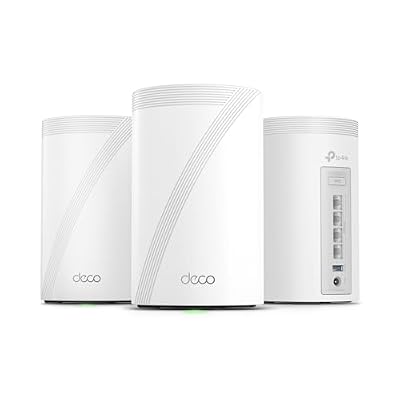
Deco 7 Pro Tri-Band WiFi 7
9.6/10 Our scoreTop scored: 9.4/10 or higher
- Color
- White
- Size
- 3 Pack
- Dimensions
- 4.23 x 4.23 x 6.93 inches
Best for: Multi-gigabit fiber networks and heavy traffic
Pros
- Wi-Fi 7 BE10000 Tri-Band speeds
- 10G and 2.5G Ethernet ports
- Built-in VPN client and server
Cons
- Higher hardware complexity
- Overkill for standard sub-gigabit connections
At the apex of residential networking performance, the Deco 7 Pro Tri-Band WiFi 7 three-pack introduces high-bandwidth IEEE 802.11be architecture into whole-home distribution. This BE10000 tri-band platform delivers combined theoretical transfer rates up to 10 Gbps across three discrete spectrum allocations: 5,188 Mbps on the 6 GHz band, 4,324 Mbps on the 5 GHz band, and 574 Mbps on the 2.4 GHz band. With a stated reach spanning up to 7,600 square feet, the system effortlessly coordinates over 200 connected clients, making it an exceptional choice for modern smart homes with high data density.
Hardware engineering on the deco 7 pro represents a massive leap forward in wired port capacity. Each unit is equipped with four 2.5G WAN/LAN ports alongside an ultra-high-speed 10G port, eliminating the traditional Gigabit bottleneck on modern multi-gigabit fiber connections. A built-in USB 3.0 port supports local storage sharing across the Omada operating platform. Crucially, the system features simultaneous wired and wireless backhaul balancing, aggregating traffic across its high-frequency wireless channels and high-speed Ethernet interfaces to guarantee zero packet loss during node-to-node handoffs.
Advanced administrative tools include integrated VPN Client and Server support, enabling hardware-level network tunneling without installing separate software packages on individual client devices. While the Deco 7 Pro delivers unparalleled technical headroom, its cutting-edge 6 GHz and 10 Gbps features provide little tangible benefit on standard broadband tiers below 1 Gbps. It is built specifically for performance-focused households utilizing ultra-fast fiber connections and dense local streaming environments.
- BE10000 tri-band Wi-Fi 7 throughput with 6 GHz, 5 GHz, and 2.4 GHz radios
- Ultra-wide coverage up to 7,600 square feet supporting 200 plus client devices
- Four 2.5G ports, one 10G port, and a USB 3.0 interface on every node
- Simultaneous wired and wireless backhaul integration with onboard VPN support
TP-Link Deco XE75 AXE5400 Tri-Band WiFi

TP-Link Deco XE75 AXE5400 Tri-Band WiFi
9.6/10 Our scoreTop scored: 9.4/10 or higher
- Color
- Black and White
- Size
- 3 Pack
- Dimensions
- 4.13 x 4.13 x 6.65 Inches
Best for: Interference-heavy homes needing dedicated 6 GHz backhaul
Pros
- Tri-band with clean 6 GHz channel
- Covers up to 7,200 square feet
- CISA Secure-by-Design certification
Cons
- Ethernet ports capped at Gigabit speeds
- 6 GHz range attenuates through thick walls
The TP-Link Deco XE75 AXE5400 Tri-Band WiFi three-pack bridges mainstream Wi-Fi 6 hardware and advanced networking by utilizing the clear, non-overlapping 6 GHz frequency band. Across its three discrete radios, this system produces an aggregate data transfer rate of 5,400 Mbps: 2,402 Mbps on 6 GHz, 2,402 Mbps on 5 GHz, and 574 Mbps on 2.4 GHz. Blanketing footprints up to 7,200 square feet, the system accommodates up to 200 devices while successfully bypassing radio frequency congestion from neighbors and legacy home appliances.
The defining technical feature of this tp-link deco xe75 package is its intelligent spectrum allocation. By default, the firmware designates the pristine 6 GHz band as a dedicated wireless backhaul corridor between the three nodes, preserving total bandwidth on the 5 GHz and 2.4 GHz bands for client traffic. Alternatively, users can toggle the 6 GHz radio to serve as an open network for newer Wi-Fi 6E smartphones, tablets, and gaming consoles. Connecting peripheral power gear like an anker outlet adapter ensures clean physical cable management near your primary modem and remote node locations.
Every node in this tp-link deco mesh extender setup contains three Gigabit Ethernet interfaces, giving you nine wired ports in total. The system operates on specialized TP-Link Firmware, backed by HomeShield network inspection, Quality of Service queuing, and CISA Secure-by-Design compliance. TP-Link backs the XE75 with its standard two-year warranty and 24/7 technical support. The primary hardware limitation is the lack of multi-gigabit Ethernet jacks; while the wireless radios support multi-gigabit aggregate data, individual wired handoffs remain limited to 1,000 Mbps per port.
- AXE5400 tri-band Wi-Fi 6E delivering up to 5,400 Mbps total throughput
- Dedicated 6 GHz wireless backhaul channel to eliminate client congestion
- Expansive physical coverage spanning up to 7,200 square feet across three nodes
- Three Gigabit Ethernet ports per chassis with 2-year warranty protection
What Sets These Models Apart
Selecting the best tp-link deco for home coverage requires evaluating internal radio capacity against the physical ports available on each station. The table below outlines how these six hardware configurations compare across essential networking metrics.
| Model | Wi-Fi Standard | Rated Coverage | Ethernet Interface | Backhaul Architecture |
|---|---|---|---|---|
| TP-Link Deco WiFi 6 Mesh WiFi (X20 1-Pack) | Wi-Fi 6 (802.11ax) | Up to 2,200 sq. ft. | 2x Gigabit Ports | Shared Dual-Band Wireless or Gigabit Ethernet |
| TP-Link Deco X55 AX3000 WiFi 6 (3-Pack) | Wi-Fi 6 (802.11ax) | Up to 6,500 sq. ft. | 3x Gigabit Ports per unit | Shared Dual-Band Wireless or Gigabit Ethernet |
| TP-Link Deco X55 AX3000 WiFi 6 (1-Pack) | Wi-Fi 6 (802.11ax) | Up to 2,500 sq. ft. | 3x Gigabit Ports | Shared Dual-Band Wireless or Gigabit Ethernet |
| TP-Link Deco S4 Mesh AC1900 WiFi (3-Pack) | Wi-Fi 5 (802.11ac) | Up to 5,500 sq. ft. | 2x Gigabit Ports per unit | Shared Dual-Band Wireless or Gigabit Ethernet |
| Deco 7 Pro Tri-Band WiFi 7 (3-Pack) | Wi-Fi 7 (802.11be) | Up to 7,600 sq. ft. | 1x 10G, 4x 2.5G per unit | Simultaneous Wired & Wireless Tri-Band Backhaul |
| TP-Link Deco XE75 AXE5400 Tri-Band WiFi (3-Pack) | Wi-Fi 6E (802.11ax) | Up to 7,200 sq. ft. | 3x Gigabit Ports per unit | Dedicated 6 GHz Wireless or Gigabit Ethernet |
Buying Tips for TP-Link WiFi Extenders
When selecting a deco internet extender platform, your home’s existing structural wiring should dictate whether you prioritize dual-band or tri-band hardware. Dual-band models like the Deco X20, Deco X55, and Deco S4 must split their 5 GHz radio airtime between talking to client devices and relaying data back to the primary base station. If your home features pre-installed Cat5e or Cat6 wall jacks, you can connect these affordable dual-band units via wired Ethernet backhaul, effectively bypassing wireless backhaul penalties and maximizing usable throughput in every room.
If running physical cables between rooms is impossible, investing in a tri-band system such as the Deco XE75 or Deco 7 Pro is vital for preventing speed loss. Tri-band architecture reserves a high-frequency spectrum corridor—such as the clear 6 GHz band on the XE75—exclusively for communication between mesh nodes. This ensures client devices operating on 2.4 GHz and 5 GHz enjoy full channel access without competing against the system’s own relay data. Take note of wall density, as high-frequency 6 GHz signals encounter faster attenuation through masonry and thick plaster than lower frequencies.
Finally, inspect physical Ethernet port allocations and long-term firmware assurances before finalizing your choice. Systems offering three ports per node, such as the Deco X55 and XE75, provide significant flexibility for hardwiring smart home hubs, gaming setups, and local storage without relying on external desktop switches. TP-Link models covered by CISA Secure-by-Design pledges and backed by two-year hardware warranties provide superior software maintenance and security updates compared to standard single-year networking equipment.
FAQ
Can all TP-Link Deco units work together on the same network?
Yes, all TP-Link Deco mesh models are designed to operate cooperatively under a unified network name and management application. You can integrate an entry-level Deco X20 or older Deco S4 into an existing network powered by a high-end Deco XE75 or Deco 7 Pro gateway. However, overall transmission efficiency across roaming points will be dictated by the local capabilities of the specific node your device connects to, and advanced features like Wi-Fi 7 Multi-Link Operation will only apply between compatible hardware.
How does wired Ethernet backhaul improve mesh stability?
Wired Ethernet backhaul connects mesh nodes directly using physical network cables rather than over-the-air wireless radio links. This setup frees up wireless channel capacity for client devices, completely eliminates signal drop caused by physical walls or distance between nodes, and maintains consistent low latency across the entire property. All Deco systems listed support auto-sensing wired backhaul routing.
What is the benefit of a dedicated 6 GHz backhaul band?
A dedicated 6 GHz backhaul channel, present on the Deco XE75, isolates internal node-to-node relay traffic onto clean, non-congested radio spectrum. Legacy wireless devices operate on 2.4 GHz and 5 GHz bands, leading to channel contention in dense neighborhoods. Offloading backhaul data to 6 GHz ensures that satellite nodes receive peak data transfer speeds from the primary gateway without consuming client device airtime.
Do TP-Link Deco extenders require an existing router?
No, TP-Link Deco units feature built-in routing software and can connect directly to your internet service provider modem to serve as your primary whole-home router. However, if your internet provider requires you to use their proprietary gateway, every Deco model listed supports Access Point mode, which disables the Deco’s routing functions to prevent double-NAT conflicts while still broadcasting a seamless mesh network.
What warranty and technical support does TP-Link provide for Deco systems?
TP-Link provides a two-year limited hardware warranty on the majority of its home mesh networking platforms, including the Deco X55 and Deco XE75, which offers an additional year of protection compared to many networking brands. In addition, TP-Link maintains 24/7 technical customer support via phone and online assistance to assist homeowners with configuration, backhaul optimization, and warranty replacements.
Prices and specifications on this page are read from the Amazon product listing and can change at any time. Scores are out of 10, based on listed specifications and buyer feedback. Nobody at this site handled or measured these products.