Power & Outdoors 3 models
Callsun 400W Solar Panel Comparison: Durability and Reliability Review
As Amazon Associates, we earn from qualifying purchases. This means we may receive a small commission at no extra cost to you if you click through and make a purchase.
Selecting the right callsun 400w solar panel setup requires balancing cell efficiency, roof geometry, thermal degradation limits, and long-term mechanical resilience. Off-grid power systems demand solar arrays that generate predictable energy under real-world stress, including partial shading from roof fixtures, intense summer heat on metal van roofs, and physical vibrations during highway travel. Choosing between rigid glass bifacial modules and bendable ETFE laminates fundamentally dictates how your system mounts, how much structural weight your vehicle bears, and how many seasons the cells will produce near their rated output before environmental wear takes a toll.
This callsun solar panel comparison examines three specific 400W-class configurations from the brand: the rigid glass N-Type 16BB 400W Bifacial Solar Panel kit, the lightweight 400W Flexible Solar Panel pair, and the higher-voltage 420W N-Type 16BB Bifacial Solar Panel array. While all three packages deliver approximately 400 watts of solar harvesting potential, they differ substantially in their cell architectures, operating voltages, mechanical construction, and thermal endurance ratings. Understanding these differences ensures your charge controller operates within its peak efficiency window while protecting your battery investment.
Which Callsun Solar Panels Should You Buy
- Best for standard 12V and 24V off-grid systems: N-Type 16BB 400W Bifacial Solar Panel offers balanced voltage, durable tempered glass, and high thermal stability.
- Best for curved roofs and weight-restricted marine decks: 400W Flexible Solar Panel provides up to 240 degrees of flex, low wind resistance, and ultra-lightweight mounting.
- Best for high-voltage MPPT controllers and 48V battery banks: 420W(2x210W) N-Type 16BB Bifacial Solar Panel,Vmp delivers higher operating voltages and quarter-cut cell shade resilience.
N-Type 16BB 400W Bifacial Solar Panel
N-Type 16BB 400W Bifacial Solar Panel
9.2/10 Our score
- Color
- Black
- Size
- 200W 2-Pack Black
- Dimensions
- 51.3385826248 x 30.314960599 x 1.3779527545 inches
Best for: RV roofs and 60V portable power stations
Pros
- 6% high cell efficiency
- Dual-module anti-shade parallel design
- High 185°F thermal limit
- IP68 waterproof junction box
Cons
- Rigid glass adds roof weight
- Requires flat mounting surface
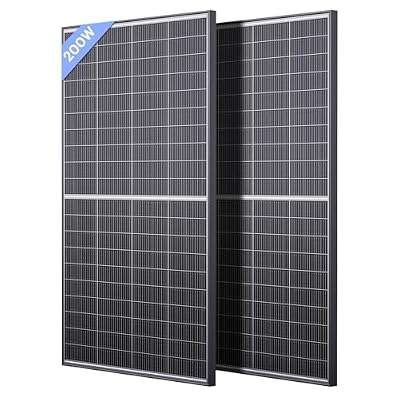
The N-Type 16BB 400W Bifacial Solar Panel kit consists of two individual 200W rigid modules engineered specifically for off-grid rooftops, marine craft, and camper conversions. Built with advanced N-type monocrystalline cells and dense 16-busbar (16BB) architecture, this array achieves a 25.6% cell conversion efficiency. The 16BB design creates shorter current pathways across each silicon wafer, which significantly reduces internal electrical resistance and limits the formation of localized hot spots. When wired in series, the two panels generate a combined 400W output with an operating voltage (Vmp) of 47.48V, an open-circuit voltage (Voc) of 54.62V, and an operating current of 8.43A. This electrical profile is specifically tailored for modern solar generators and power stations with 60V maximum solar input limits, allowing users to maximize energy intake without exceeding controller thresholds, much like standard commercial configurations discussed in our ecoflow 400w solar panel guides.
A central engineering strength of this callsun 200w solar panel pair is its bifacial optical design paired with a TwinCell anti-shading layout. The rear transparent backsheet allows the cells to absorb ambient, diffuse, and ground-reflected sunlight, adding supplementary energy harvest when mounted on reflective surfaces such as light-colored RV roofs, marine gelcoat, or snow. Mechanically, the panel divides each module into two parallel sections. If air conditioners, luggage racks, or tree branches shade one side of the panel, the opposite half continues operating without pulling down total circuit throughput. Each individual panel measures 51.3 by 30.3 by 1.4 inches and weighs 23.8 pounds, featuring heavy-duty 3.2mm tempered glass framed in anodized aluminum alloy.
Thermal stability is another critical factor for mobile installations where rooftop temperatures regularly soar. This callsun bifacial solar panel carries an upper temperature rating of 185 degrees Fahrenheit (85 degrees Celsius) and features a low temperature coefficient of -0.30%/K. This low coefficient minimizes power loss during peak midday summer heat compared to older P-type solar cells. For environmental protection, the junction box holds an IP68 waterproof rating. In terms of callsun solar warranty coverage, the listing states that these rigid panels are backed by 10 years of technical support alongside a 25-year performance commitment. This model suits off-grid builders who have adequate flat roof space and prioritize structural rigidity, though buyers with severely curved vehicle roofs will need to look toward flexible alternatives.
- Advanced N-type monocrystalline cells with 16BB busbars achieving 25.6% efficiency
- TwinCell dual-module parallel anti-shade design to maintain generation during partial obstruction
- Optimized electrical parameters for 60V-class portable solar inputs at 47.48V series Vmp
- Heavy-duty 3.2mm tempered glass, corrosion-resistant frame, and IP68-rated junction box
400W Flexible Solar Panel

400W Flexible Solar Panel
9.6/10 Our scoreTop scored: 9.4/10 or higher
- Color
- White
- Size
- 200W
- Dimensions
- 62.1 x 31.7 x 0.1 inches
Best for: Curved vehicle roofs and weight-sensitive marine decks
Pros
- 240° bendable flexible profile
- Ultra-lightweight 9.3 lb build
- Durable ETFE protective coating
- Heat-reflective white backsheet
Cons
- Lower 158°F upper temperature limit
- Shorter 5-year material warranty
The 400W Flexible Solar Panel package contains two 200W bendable units (model CS-R200W-W) designed for installations where traditional rigid aluminum frames cannot be mounted. Engineered with an ultra-thin 0.1-inch profile and an extreme bend radius of up to 240 degrees, these panels conform tightly to curved camper van roofs, teardrop trailers, boat decks, and airstream hulls. Each panel weighs just 9.3 pounds, representing an approximate 50% to 60% weight reduction compared to framed glass panels of similar output. This lightweight profile reduces the center of gravity on recreational vehicles and eliminates the aerodynamic drag associated with tall mounting brackets, making them popular callsun rv solar panels for high-top fiberglass shells.
Beneath the surface, the assembly features monocrystalline silicon cells utilizing 11-busbar technology with a stated 23.5% conversion efficiency. Each 200W panel produces a maximum operating voltage (Vmp) of 18.2V and an operating amperage of 11A, utilizing integrated bypass diodes to safeguard the cells against shadow-induced current blockages. Rather than using conventional PET plastic films that degrade and discolor under ultraviolet exposure, Callsun uses a multi-layer ETFE coating. This ETFE exterior provides increased resistance to hail strikes, surface yellowing, and thermal cracking. The panel also incorporates a heat-reflective white backsheet designed to reject excess thermal energy, helping the cells operate closer to their optimal temperature curve on dark surfaces.
While flexible panels solve complex aerodynamic and structural challenges, buyers must weigh their mechanical tradeoffs. Without the heat dissipation space provided by the standoff brackets used on framed panels, flexible panels sit flush against the mounting surface, which can increase operating temperatures. The listing specifies an upper temperature limit of 158 degrees Fahrenheit (70 degrees Celsius), which is lower than the 185-degree threshold of Callsun’s tempered glass models. Furthermore, the warranty terms reflect the physical realities of flexible laminates: Callsun provides a 5-year material warranty and a 7-year performance commitment for this model, compared to the 25-year performance terms on their rigid units. This product is ideal for boat owners and curved van builds where mechanical flex and zero-clearance adhesion are mandatory, but stationary off-grid cabins should choose rigid frames for maximum multi-decade durability.
- Exceptional 240-degree flexibility for mounting on curved marine decks and teardrop RV roofs
- Ultra-lightweight 9.3-pound construction with an ultra-slim 0.1-inch profile
- Protective ETFE outer coating resists UV yellowing, cracking, and outdoor weathering
- Heat-reflective white backsheet paired with internal bypass diodes for thermal management
420W(2x210W) N-Type 16BB Bifacial Solar Panel,Vmp

420W(2x210W) N-Type 16BB Bifacial Solar Panel,Vmp
9.0/10 Our score
- Color
- Black
- Size
- 2PCS 210W
- Dimensions
- 54.2 x 30.2 x 1.4 inches
Best for: High-voltage MPPT arrays and 48V systems
Pros
- High 34.2V operating voltage
- Quarter-cut 16BB microcrack resistance
- Up to 30% bifacial albedo gain
- 25-year 84.5% output guarantee
Cons
- Heavier 24.9 lb panel weight
- Exceeds low-voltage controller limits in series
The 420W(2x210W) N-Type 16BB Bifacial Solar Panel,Vmp kit represents Callsun’s highest-power and highest-voltage rigid offering in this category. Delivering 420 watts across two 210W modules, this setup leverages quarter-cut N-type monocrystalline cells with a dense 16-busbar network, delivering a 25.6% conversion efficiency. A distinguishing technical spec is its electrical output: each individual panel operates at a high Vmp of 34.2V and an output voltage (Voc) of 40.3V, while maintaining a lower operating current of 6.1A. This elevated voltage configuration makes the array exceptionally versatile for 12V, 24V, and 48V battery systems, allowing modern MPPT charge controllers to step down voltage smoothly with minimal line losses over long wiring runs.
This model is built with Callsun’s Dual-Module parallel anti-shade design, splitting the panel into two independent circuits to mitigate energy loss from localized rooftop shadows like vent pipes, air conditioners, and roof racks. Because the cells are quarter-cut, internal electrical resistance is reduced, which helps limit thermal buildup across the busbars. The listing notes that the dense 16BB current grid actively limits the power degradation typically caused by microcracks developed during rough travel over unpaved roads. The bifacial cell architecture captures reflected albedo light through the rear glass, capable of generating up to 30% supplemental energy gain when installed above light-colored RV roofs, white membranes, or snow. Similar high-voltage architectures are explored when assessing commercial alternatives in our renergy solar panels technical guides.
Each 210W module measures 54.2 by 30.2 by 1.4 inches and weighs 24.9 pounds, featuring 3.2mm tempered glass set in a rugged anodized aluminum alloy frame. The panel carries an upper operating temperature rating of 85 degrees Celsius (185 degrees Fahrenheit). The listing highlights direct plug-and-play parallel charging compatibility with various portable power stations from major manufacturers, provided the controller matches the voltage window. Warranty coverage is robust, featuring a 10-year workmanship guarantee and a 25-year power output guarantee that pledges 84.5% output retention over 25 years. This panel is the premier choice for stationary off-grid homesteads, skoolies, and overland rigs requiring high electrical efficiency and elevated voltage headroom, trading away the lightweight convenience of flexible panels for maximum longevity and severe-duty build quality.
- High-voltage 34.2V Vmp per panel ideal for 12V to 48V MPPT solar battery systems
- Quarter-cut N-type cells with 16BB architecture to minimize microcrack power drop
- Bifacial design offering up to 30% supplemental gain from surface-reflected sunlight
- Backed by a 10-year workmanship warranty and a 25-year 84.5% power output guarantee
What Sets These Models Apart
Choosing which callsun solar panel to buy requires matching the panel’s mechanical construction and electrical characteristics to your specific off-grid installation. The rigid N-type modules excel in long-term structural resilience and heat resistance, whereas the ETFE flexible panels prioritize low weight and conformability to irregular surfaces. Voltage differences between the 200W and 210W rigid panels also dictate how each array pairs with MPPT controllers and battery banks of differing voltages.
| Feature | N-Type 16BB 400W Bifacial | 400W Flexible Solar Panel | 420W N-Type 16BB Bifacial |
|---|---|---|---|
| Cell Type & Efficiency | N-Type 16BB Monocrystalline (25.6%) | Monocrystalline 11BB (23.5%) | N-Type Quarter-Cut 16BB (25.6%) |
| Voltage & Current (Per Panel) | 23.74V Vmp / 8.43A | 18.2V Vmp / 11.0A | 34.2V Vmp / 6.1A |
| Weight & Thickness | 23.8 lbs / 1.4″ thick | 9.3 lbs / 0.1″ thick | 24.9 lbs / 1.4″ thick |
| Maximum Temperature Rating | 185 °F (85 °C) | 158 °F (70 °C) | 185 °F (85 °C) |
| Warranty Terms | 10-yr tech support / 25-yr performance | 5-yr material / 7-yr power commitment | 10-yr workmanship / 25-yr 84.5% power |
As shown in the table, the 420W kit operates at a significantly higher voltage (34.2V Vmp per panel) compared to the 400W rigid kit (23.74V Vmp per panel) and the flexible panel (18.2V Vmp). This makes the 420W model superior for longer wire runs where voltage drop is a concern, whereas the lower-voltage 400W rigid kit in series matches portable power stations that impose strict 60V DC maximum input ceilings. Meanwhile, the flexible panel cuts system weight by more than half, accommodating curved mounting surfaces where rigid glass cannot physically install.
Buying Tips for Callsun Solar Panels
Before mounting any callsun 400w solar panel on your rig, evaluate the structural profile and thermal dynamics of your installation site. Rigid solar panels with aluminum frames require Z-brackets or strut channels that elevate the panel roughly one to two inches above the vehicle roof. This elevation creates an essential convective airflow channel beneath the glass, which sheds heat and prevents the cells from reaching thermal throttling thresholds. In contrast, flexible ETFE panels are typically glued or taped directly to vehicle fiberglass or sheet metal. Because flush-mounted flexible panels cannot vent heat from below, they operate at higher cell temperatures, which can reduce instantaneous efficiency during hot summer days. If you are comparing mobile setups against larger off-grid generators analyzed in our jackery 500w solar panel reviews, always prioritize thermal dissipation when mounting hardware on dark roofs.
Pay close attention to charge controller compatibility, specifically minimum start-up voltages and maximum input voltage limits (Voc). When wiring two panels in series, their voltages add together while amperage remains constant; when wiring in parallel, amperage doubles while voltage stays equal. If you choose the Callsun 420W kit, wiring two 40.3V Voc panels in series yields over 80V open-circuit, which requires an MPPT controller rated for at least 100V. Conversely, the Callsun 400W rigid kit provides 54.62V Voc in series, which fits beneath the 60V solar input limit found on many portable power stations. Connecting high-amperage panels, such as the 11A flexible modules, in parallel requires verifying that your charge controller’s solar input can accept 22A without clipping your solar harvest.
Finally, factor warranty terms and cell construction into your lifecycle expectations. Rigid callsun bifacial solar panel models incorporate heavy 3.2mm tempered glass, solid aluminum frames, and quarter-cut or 16BB cell designs that resist the microcracking caused by highway vibration and frame twisting. These structural advantages are why Callsun provides 25-year performance commitments on its rigid panels. Flexible panels, while convenient and aerodynamic, flex under highway wind buffeting, and their polymer layers experience gradual thermal fatigue over time. Treat flexible panels as specialized solutions for weight-critical or curved applications with an expected 5- to 7-year service horizon, while choosing rigid glass panels for long-term off-grid reliability.
FAQ
Can Callsun bifacial solar panels generate power when mounted flat on an RV roof?
Yes, Callsun bifacial panels generate their primary power from the top monocrystalline glass face regardless of mounting angle. However, to capture the additional rear-side gain through the transparent backsheet, the panels require reflected ambient light. Mounting them flat with standard brackets on a white or light-colored RV roof will yield modest backside energy harvesting. Maximum bifacial gain occurs when the panels are tilted on ground mounts or elevated brackets over reflective surfaces like white membrane roofs, sand, or snow.
How does the Callsun Dual-Module anti-shading design protect power output?
Standard solar panels often suffer severe power drops when a single shadow crosses an edge, as conventional cell strings shut down entirely under localized obstruction. Callsun’s Dual-Module parallel architecture splits the panel internally into two independently functioning halves. When shadows from roof vents, air conditioning units, or overhead trees cover one section of the panel, the unaffected half continues to generate power at full current. This parallel configuration helps maintain steady battery charging under imperfect field conditions.
What are the primary longevity differences between Callsun ETFE flexible panels and rigid glass panels?
The primary difference lies in mechanical protection and thermal tolerance. Rigid Callsun panels use 3.2mm tempered glass and aluminum framing to shield silicon cells from twisting, hail, and vibration, carrying an upper thermal rating of 185 degrees Fahrenheit and 25-year performance commitments. The flexible ETFE panels use polymer laminates rated to 158 degrees Fahrenheit with a 5-year material warranty and 7-year power commitment. While ETFE resists yellowing far better than cheap PET films, flexible laminates are naturally more vulnerable to microcracks from continuous wind flexing and heat retention.
How do I determine whether to wire two Callsun panels in series or parallel?
Wiring in series combines panel voltages while keeping amperage the same, which helps MPPT controllers begin charging earlier in low-light mornings and reduces power losses over long cable runs. However, the total combined open-circuit voltage (Voc) must remain comfortably below your controller’s maximum voltage rating. Wiring in parallel doubles amperage while keeping voltage low, which is ideal when using charge controllers with lower voltage ceilings, though it requires heavier-gauge wire to handle the increased current without resistive heating.
What should I inspect if a Callsun solar array produces less wattage than expected?
First, inspect the solar angle and ambient surface temperatures, as solar panels lose efficiency as temperatures rise beyond standard test conditions (77 degrees Fahrenheit). Second, check your charge controller’s maximum solar input amperage limit to confirm it is not throttling generation. Finally, verify that all solar connectors are firmly seated, inspect the panels for localized shading across both parallel halves, and ensure that the battery bank is not already near full capacity, which causes charge controllers to dial back incoming power automatically.
Prices and specifications on this page are read from the Amazon product listing and can change at any time. Scores are out of 10, based on listed specifications and buyer feedback. Nobody at this site handled or measured these products.