Tools & Garden 6 models
Anycubic 3D Printer Lineup: Reliability and Hardware Longevity Compared
As Amazon Associates, we earn from qualifying purchases. This means we may receive a small commission at no extra cost to you if you click through and make a purchase.
Choosing the right machine among current any cubic 3d printers comes down to matching your intended material types and build sizes against specific mechanical drive systems. Anycubic manufactures two distinct categories of hardware: filament-based machines spanning open-frame bedslingers and enclosed CoreXY units, alongside high-precision resin vats powered by monochrome LCD panels. Evaluating these platforms from a maintenance and longevity perspective requires inspecting kinematic components such as ball screws, gantry stiffness, heated chamber integration, and automated sensor suites that reduce routine manual calibration.
This comprehensive Anycubic 3D printer comparison covers exactly six distinct machines from the manufacturer’s lineup: four multi-material filament systems and two ultraviolet liquid resin models. Each machine approaches mechanical stability, extrusion flow, and layer adhesion differently, presenting distinct trade-offs between mechanical simplicity and high-speed execution. Whether you require an entry-level multicolor bedslinger for household craft projects or an industrial-grade heated chamber for warp-prone polymers, this guide breaks down the hardware reality behind each option to reveal the best Anycubic 3D printer for your workshop.
Which Anycubic 3D Printers Should You Buy
- Anycubic Kobra X Multicolor 3D Printer: Best for multi-material makers needing up to nineteen colors with high-temperature filament support up to 300℃.
- ANYCUBIC Kobra X Fast 3D Printer: Best for families and educators prioritizing a quiet 45dB sound profile, rapid assembly, and camera-based error pausing.
- Anycubic Kobra S1 Combo Multicolor 3D: Best for intermediate hobbyists seeking high acceleration and continuous 24/7 material drying inside an enclosed CoreXY framework.
- Anycubic Kobra S1 Max Combo 3D: Best for engineering prototypes, full-scale architectural prints, and large enclosures demanding a 350x350x350 mm³ build envelope with an actively heated chamber.
- ANYCUBIC Photon Mono 4: Best for tabletop gamers and miniature collectors seeking tight 10K screen resolution without complex networking features.
- ANYCUBIC Photon P1 14K Resin 3D: Best for commercial prototyping labs requiring automatic resin leveling, sensor-assisted vat release, and high-viscosity engineering resin support.
Anycubic Kobra X Multicolor 3D Printer

ANYCUBIC Kobra X Fast 3D Printer
8.4/10 Our score
- Color
- Grey
- Dimensions
- 17.93 x 17.53 x 18.16 inches
- Weight
- 20.94391489 Pounds
Best for: Classrooms and quiet home workshops
Pros
- Low 45dB quiet operating sound
- Built-in 720P AI monitoring camera
- Fast 15-minute modular assembly
Cons
- Gantry format requires overhead clearance
- Replacement parts program dependent on external logistics

Anycubic Kobra X Multicolor 3D Printer
9.4/10 Our scoreTop scored: 9.4/10 or higher
- Color
- Grey
- Dimensions
- 23 x 13 x 22 inches
- Weight
- 20.94391489 pounds
Best for: Makers seeking expandable multicolor desktop printing
Pros
- Native four-color printing capability
- Hardened steel nozzle reaches 300℃
- Automatic LeviQ 3.0 49-point calibration
Cons
- Filament not included in package
- Large 23-inch depth requirement
The Anycubic Kobra X Multicolor 3D Printer is an open-format filament machine engineered for rapid setup and expansive color handling. Built with a sturdy metal frame and finished in grey, this model incorporates native four-color feeding straight from the factory and allows creators to scale up to nineteen colors by linking four separate ACE 2 Pro units. To maintain smooth flow across rapid color transitions, the internal mechanics cut machine travel and purge distance by 81.25 percent, doubling overall production speed while halving filament purge scrap during multi-tone layer generation.
From an operational reliability perspective, this Anycubic multicolor 3D printer addresses bed adhesion and mechanical wear using hardened steel nozzle hardware capable of sustaining 300℃ extrusion temperatures. First-layer consistency is governed by Anycubic’s LeviQ 3.0 system, which deploys a 49-point matrix calibration algorithm across the build plate. While comparing options against a bambu lab 3d printer combo, buyers will appreciate the integrated dual-band Wi-Fi and wired LAN options on this unit, allowing straightforward remote oversight through the Anycubic mobile application and slicer software.
This model is ideal for hobbyists, maker clubs, and design studios seeking an adaptable filament workhorse capable of printing technical filaments like ASA, PETG, and flexible TPU alongside baseline PLA. Prospective owners should note that spools are not bundled in the initial package, so filament stocks must be secured separately before beginning the initial 15-minute commissioning sequence.
- Native four-color printing expandable up to nineteen colors via four ACE 2 Pro units
- LeviQ 3.0 auto-leveling system utilizing a 49-point matrix calibration algorithm
- Hardened steel nozzle with 300℃ maximum temperature and vibration compensation
- Dual-band 2.4G and 5G Wi-Fi with wired LAN connectivity and AI failure detection
ANYCUBIC Kobra X Fast 3D Printer
ANYCUBIC Kobra X Fast 3D Printer
8.4/10 Our score
- Color
- Grey
- Dimensions
- 17.93 x 17.53 x 18.16 inches
- Weight
- 20.94391489 Pounds
The ANYCUBIC Kobra X Fast 3D Printer shares the grey metal chassis architecture of its sibling but optimizes the platform specifically for quiet operation and accessible household integration. Producing just 45dB of noise during operation, it functions at a sound pressure lower than normal indoor speaking levels, making it suitable for bedrooms, living areas, or study desks. The machine arrives predominantly pre-assembled in modular sections, ensuring users can transition from opening the crate to melting filament in roughly 15 minutes.
Operational safety and mechanical reliability take center stage through an onboard AI monitoring system backed by a 720P camera. The camera continuously evaluates the build surface to detect foreign objects or detached spaghetti strands, halting mechanical motion automatically and sending push alerts to the operator’s smartphone. Similar to dedicated educational systems like the aoseed ai 3d printer for kids, this model relies on protective automation to prevent nozzle strikes and minimize messy print failures. Leveling precision is handled by the LeviQ 3.0 architecture, delivering 0.02mm accuracy across 49 contact points across the XYZ gantry.
This unit is exceptionally well suited for schools, novices, and home crafters wanting native four-color printing without the steep learning curves of manual bed tuning. Long-term maintainability is also supported by the machine’s official enrollment in the Amazon Replacement Parts Program, simplifying part sourcing if wear items need replacement down the road.
- Ultra-quiet 45dB acoustic profile tailored for domestic and classroom printing
- Pre-assembled modular assembly allowing initial printing within 15 minutes
- Integrated 720P camera with real-time AI foreign object and spaghetti detection
- Enrolled directly in the Amazon Replacement Parts Program for straightforward upkeep
Anycubic Kobra S1 Combo Multicolor 3D
Anycubic Kobra S1 Max Combo 3D
8.6/10 Our score
- Color
- Black
- Dimensions
- 21 x 23 x 19 inches
Best for: Engineers producing large single-piece functional assemblies
Pros
- Massive 350x350x350mm³ build volume
- Active 65°C heated enclosure
- High-temperature 350°C hotend
Cons
- Heavy 77.8-pound physical frame
- Significant bench space consumption

Anycubic Kobra S1 Combo Multicolor 3D
8.2/10 Our score
- Color
- Black
- Size
- Anycubic Kobra S1 Combo
- Dimensions
- 19.06 x 19.29 x 22.56 inches
Best for: Users printing moisture-sensitive technical filaments
Pros
- Integrated 24/7 active ACE PRO dryer
- Sturdy CoreXY motion structure
- Dynamic flow calibration minimizes blobbing
Cons
- Substantial 56-pound unit mass
- Complex dual-box setup for eight colors
The Anycubic Kobra S1 Combo Multicolor 3D shifts mechanical philosophy toward a rigid CoreXY frame design, encased in a black enclosure that provides superior rigidity against rapid directional changes. Weighing an authoritative 56 pounds, this machine employs a balanced kinematic layout capable of reaching 20,000 mm/s² acceleration and maximum travel speeds of 600mm/s. CoreXY belt routings isolate moving masses to the gantry, preventing the bed inertia issues common to open-air bedslingers when executing complex geometries at high velocity.
A primary failure point in multicolor printing is moisture absorption, which degrades layer bonding and causes nozzle jams. The Kobra S1 Combo solves this by integrating the Anycubic ACE PRO unit, an active filament dryer that runs continuously 24/7—even during active printing cycles. Extrusion reliability is further bolstered by proprietary Anycubic Kobra OS flow correction, which calculates pressure dynamics to prevent plastic pooling or blobbing around tight directional shifts.
This platform suits dedicated makers who regularly print technical materials like ABS, ASA, and PETG alongside high-speed PLA variants. While managing physical footprint, buyers should consider that the 56-pound frame requires a sturdy workbench capable of handling high kinetic acceleration without swaying or transmitting vibrations to adjacent equipment.
- High-stability CoreXY structural frame supporting 20,000 mm/s² acceleration
- Included Anycubic ACE PRO module provides active 24/7 inline filament drying
- Anycubic Kobra OS flow correction reduces corner blobbing and seam artifacts
- Four-color out-of-the-box printing expandable to eight colors using dual ACE units
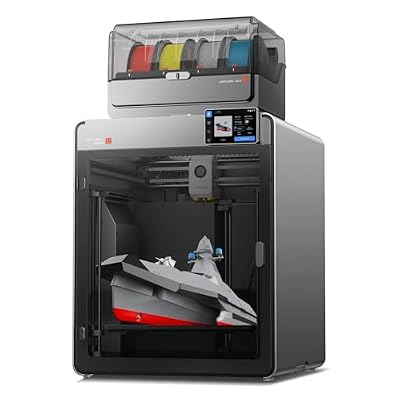
Anycubic Kobra S1 Max Combo 3D
Anycubic Kobra S1 Max Combo 3D
8.6/10 Our score
- Color
- Black
- Dimensions
- 21 x 23 x 19 inches
The Anycubic Kobra S1 Max Combo 3D represents the heavy-duty tier of Anycubic’s CoreXY stable, delivering an expansive 350x350x350 mm³ build envelope. Weighing 77.8 pounds, this all-metal enclosed machine is built to manufacture full-scale mechanical prototypes, industrial casings, and structural components in a single operation, eliminating the need to split digital files and assemble segmented parts later.
Large ABS and ASA components are notorious for warping off build plates due to uneven cooling gradients. The S1 Max Combo directly combats this thermal failure mode with an active 65°C heated build chamber paired with a high-temperature 350°C hotend. First-layer precision across the massive heated surface is governed by the LeviQ 3.0 49-point auto-leveling array coupled with real-time flow dynamic calibration, ensuring reliable polymer adhesion right from the initial skirt. High-speed performance remains intact despite the large scale, with velocity rates up to 600mm/s enabling a standard Benchy completion in approximately 15 minutes.
Bundled with an ACE 2 Pro module, the machine executes four-color prints out of the box and scales up to sixteen separate filaments when paired with four units. This printer suits engineering departments, industrial makerspaces, and advanced fabricators who demand large thermal enclosures and multi-material versatility without relying on piecemeal aftermarket upgrades.
- Expansive 350x350x350 mm³ enclosed volume for large one-piece fabrications
- Actively heated 65°C chamber combined with a 350°C high-temperature hotend
- Solid all-metal CoreXY framework with 20,000 mm/s² kinematic acceleration
- Bundled ACE 2 Pro handles four colors natively and expands up to sixteen colors
ANYCUBIC Photon Mono 4

ANYCUBIC Photon Mono 4
8.0/10 Our score
- Color
- Gray
- Size
- Photon Mono 4
- Dimensions
- 10 x 10 x 15 inches
Best for: Miniature painters wanting high pixel density
Pros
- Detailed 10K resolution monochrome screen
- Laser-engraved platform ensures adhesion
- Lightweight 3.5 kg compact footprint
Cons
- No Anycubic mobile application support
- Manual four-screw bed leveling
The ANYCUBIC Photon Mono 4 steps away from filament extrusion to deliver resin-curing accuracy tailored for small-scale physical fidelity. Equipped with a 7-inch monochrome LCD sporting a 10K resolution of 9024×5120 pixels, this machine achieves a microscopic 17×17μm pixel grid along both the X and Y axes. This represents a 105 percent increase in precision compared to earlier Mono 2 hardware, rendering crisp miniature features, skin folds, and mechanical teeth with virtually no visible layer stepping.
Optical consistency is provided by the LighTurbo matrix light source, which projects uniform ultraviolet rays across the 153.4mm x 87mm x 165mm build volume to eliminate light scatter and rasterization errors. To solve the classic resin failure point of model delamination from the build plate, the Mono 4 employs a newly designed Laser-engraved Print Platform 2.0. This textured surface provides balanced mechanical tooth for initial burn-in layers while allowing smooth part release with a hand scraper once the job finishes.
With an overall mass of just 3.5 kg, this compact desktop machine is ideal for tabletop gamers, jewelry designers, and hobbyists who want sharp detail without mechanical bloat. Prospective buyers should be aware that the manufacturer explicitly notes that Anycubic mobile app services are not supported on this model, meaning prints are initiated via local physical media rather than cloud queues.
- High-density 7-inch 10K monochrome LCD screen delivering 17×17μm XY pixel size
- LighTurbo matrix light source ensures uniform UV curing across the vat surface
- Laser-engraved Print Platform 2.0 balances print adhesion with release ease
- Simplified four-point leveling mechanism with single-instance screw locking
ANYCUBIC Photon P1 14K Resin 3D

ANYCUBIC Photon P1 14K Resin 3D
9.2/10 Our score
- Color
- white
- Size
- Photon P1
- Dimensions
- 16.93 x 24.41 x 16.54 inches
Best for: Advanced resin creators printing engineering materials
Pros
- Automated Smart Leveling 3.0 sensor system
- Handles viscous resins up to 8000 cps
- Wave release cuts peel force by 60%
Cons
- Heavier 13.5 kg benchtop footprint
- Complex mechanical sensors to maintain
The ANYCUBIC Photon P1 14K Resin 3D is a heavy-duty resin manufacturing system built on an aluminum chassis weighing 13.5 kg. At its core is a 10.1-inch 14K monochrome LCD panel presenting an expansive 13,312 x 5,120 pixel resolution. With an XY pixel footprint of 16.8 x 24.8 micrometers and the ability to reproduce apertures as narrow as 0.3 millimeters, this printer provides surgical precision for advanced dental modeling, high-tolerance tooling, and professional collector statues.
Resin printing often suffers from mechanical suction forces that tear delicate supports off models during the Z-axis lift cycle. The Photon P1 incorporates proprietary Wave Release Technology, which generates micro-airflow beneath the film during plate retraction to reduce mechanical peel resistance by 60 percent. Z-axis stability is enforced by industrial-grade ball screws and precision linear guide rails, effectively eliminating vertical wobble and layer jitter. Furthermore, the unit features Smart Leveling 3.0 with real-time pressure feedback across all four corners, alongside optical AI checks that verify plate placement, resin levels, and vat debris before movement begins.
Unlike standard desktop vats that struggle with dense chemical formulations, the Photon P1 is rated to handle high-viscosity resins up to 8,000 cps—roughly 40 times thicker than standard consumer resins. This makes it an indispensable tool for commercial engineering teams working with stiff, impact-resistant industrial photopolymers.
- Large 10.1-inch 14K LCD displaying 13,312 x 5,120 pixels with 0.3mm minimum aperture
- Wave Release Technology uses micro-airflow to cut peel suction forces by 60 percent
- Automated Smart Leveling 3.0 system with corner pressure sensors and self-check routines
- Industrial ball screw Z-axis drive supporting viscous resins up to 8,000 cps
What Sets These Models Apart
Comparing these six machines reveals clear distinctions across physical architectures, kinematic stability, leveling technologies, and intended operational environments. The table below outlines key hardware specifications to help you evaluate which platform meets your workshop requirements.
| Model | Kinematic Architecture | Build Volume or Footprint | Leveling & Calibration | Material / Color Capabilities |
|---|---|---|---|---|
| Anycubic Kobra X Multicolor 3D Printer | Open Gantry Metal Frame | 23″D x 13″W x 22″H | LeviQ 3.0 (49-Point Auto Calibration) | Native 4 Colors (Expandable to 19); 300℃ Hotend |
| ANYCUBIC Kobra X Fast 3D Printer | XYZ Gantry Metal Frame | 17.93″D x 17.53″W x 18.16″H | LeviQ 3.0 (49-Point, 0.02mm Precision) | Native 4 Colors (ACE GEN 2); 45dB Quiet Operation |
| Anycubic Kobra S1 Combo Multicolor 3D | Enclosed CoreXY Structure | 8″D x 8″W x 8″H External (56 lbs) | Kobra OS Flow Calibration | Native 4 Colors (Expandable to 8); 24/7 ACE PRO Dryer |
| Anycubic Kobra S1 Max Combo 3D | Enclosed All-Metal CoreXY | 350x350x350 mm³ Print Volume | LeviQ 3.0 with Real-Time Flow Dynamics | Native 4 Colors (Expandable to 16); 65°C Heated Chamber |
| ANYCUBIC Photon Mono 4 | UV Resin LCD (LighTurbo Matrix) | 153.4 x 87 x 165 mm Build Volume | 4-Point Manual Screw Leveling | Standard Photopolymer Resins; 10K Mono Screen |
| ANYCUBIC Photon P1 14K Resin 3D | Ball Screw & Linear Guide Resin | 16.93″D x 24.41″W x 16.54″H | Smart Leveling 3.0 with Corner Pressure Sensors | High-Viscosity Resins up to 8,000 cps; 14K Screen |
Buying Tips for Anycubic 3D Printers
When assessing Anycubic 3D printer reliability across different machine classes, your primary mechanical consideration should be frame stability relative to speed. High-speed bedslingers moving an open print bed along the Y-axis inevitably encounter directional inertia, which can induce ringing on tall, slender prints at speeds exceeding 300mm/s. In contrast, fully enclosed CoreXY platforms such as the Kobra S1 series anchor the build surface vertically, restricting rapid lateral movements to a lightweight toolhead. If your workload involves tall structural prototypes or abrasive carbon-filled blends, prioritizing rigid metal CoreXY architecture ensures greater dimensional fidelity over thousands of operating hours.
Thermal management is equally crucial when choosing between open frames and heated enclosures. Filament materials such as ABS and ASA demand stable ambient chamber environments to prevent severe layer separation and edge warping. While an open-frame bedslinger equipped with a 300℃ hotend can technically melt high-temperature plastics, the lack of an enclosed, heated air zone leads to premature cooling cracks. For serious industrial engineering projects, an actively heated chamber like the 65°C enclosure found on the Kobra S1 Max Combo is essential. Buyers evaluating alternative enclosed setups can also review our flash forged 3d printer reliability breakdown for further context on high-temperature polymer handling.
For resin systems, LCD durability and peel-force mechanics dictate long-term maintenance costs. High-resolution panels, such as the 14K display on the Photon P1, require careful vat cleaning to prevent stray cured chunks from cracking the glass during descent. Features like automated vat debris scanning, dynamic pressure leveling, and pneumatic wave-release mechanisms reduce mechanical stress on both the LCD screen and the release film. Choosing a model with active sensor verification dramatically cuts down on punctured vats and expensive LCD replacements over the life of your machine.
FAQ
Which Anycubic 3D printer is best for beginners?
The ANYCUBIC Kobra X Fast 3D Printer is well suited for beginners due to its modular design that assembles in approximately 15 minutes, automated 49-point LeviQ 3.0 bed leveling, and built-in AI camera monitoring that pauses the machine if prints fail. Its quiet 45dB operation also makes it easy to integrate into household environments without noise disruption.
Can Anycubic multicolor 3D printers print different materials at the same time?
Yes, models like the Anycubic Kobra X Multicolor support mixed printing of rigid and flexible materials, including combinations of PLA, PETG, TPU, PVA, and ASA, facilitated by its 300℃ capable hardened steel nozzle and automated multi-feed routing.
What is the benefit of an actively heated chamber on the Kobra S1 Max Combo?
The 65°C heated chamber maintains a uniform ambient temperature around the model during printing, which prevents rapid cooling and thermal shrinkage. This thermal stability is essential for preventing warping, internal stress, and layer cracking when fabricating large objects from technical materials like ABS and ASA.
Does the ANYCUBIC Photon Mono 4 support remote app monitoring?
No, the listing specifies that Anycubic mobile app services are not supported on the Photon Mono 4. Sliced files must be loaded directly to the machine via physical media rather than queued through a wireless network or mobile application.
How does Wave Release Technology improve resin printing success rates on the Photon P1?
Wave Release Technology introduces micro-airflow underneath the release film while the build plate lifts, reducing the physical peel force by roughly 60 percent. Lowering this suction tension prevents delicate supports from snapping and keeps large, solid resin cross-sections securely attached to the build platform.
Prices and specifications on this page are read from the Amazon product listing and can change at any time. Scores are out of 10, based on listed specifications and buyer feedback. Nobody at this site handled or measured these products.